Infrastructure is the New ROI Engine: How Connectivity Drives Property Prices
In Real Estate, Roads Create Wealth Before Buildings Do
By PropertyPistol
For decades, property investors followed a simple rule:
Buy in a good location.
Today, that rule has evolved.
The smartest investors are no longer asking:
“Which location is good?”
They’re asking:
“Which location is about to become good?”
And the answer almost always begins with one thing.
Infrastructure.
Not the buildings.
Not the amenities.
Not even the developers.
Infrastructure.
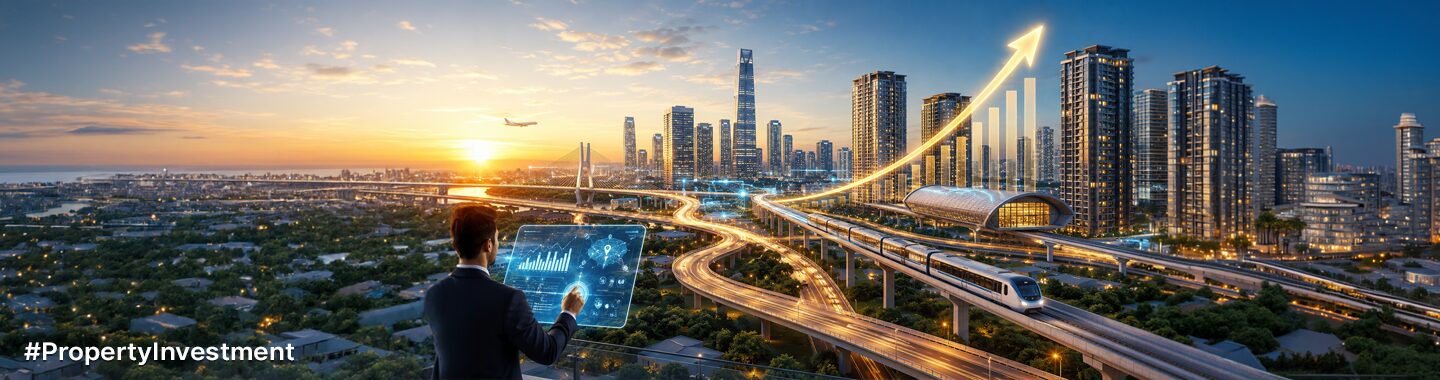
Because in modern real estate, roads, metro lines, airports, bridges, expressways, and transit corridors have become the most powerful drivers of property appreciation.
In fact, some of India’s biggest real estate wealth stories over the last two decades weren’t created by developers.
They were created by connectivity.
The lesson is simple:
Infrastructure is no longer supporting real estate. It is driving it.
The Great Shift: From Location to Accessibility
For years, location was considered the holy grail of real estate.
But location itself is becoming less important than accessibility.
Think about it.
A location is only valuable because of how easily people can reach it.
A place that once felt remote can become highly desirable after a metro line arrives.
A forgotten suburb can become an investment hotspot after an expressway opens.
A distant land parcel can suddenly become a growth corridor once an airport is announced.
The geography doesn’t change.
The connectivity does.
And when connectivity changes, perception changes.
When perception changes, demand follows.
And where demand goes, prices eventually follow too.
Why Infrastructure Creates Real Estate Wealth
Infrastructure does far more than reduce travel time.
It fundamentally changes the economics of a location.
When a new transport corridor is introduced:
✔ Businesses gain access to larger talent pools
✔ Employees gain access to more job opportunities
✔ Developers gain access to new land parcels
✔ Investors gain access to emerging growth markets
✔ Residents gain access to better lifestyles
This creates a chain reaction.
Infrastructure attracts people.
People attract businesses.
Businesses attract housing demand.
Housing demand drives property appreciation.
The process is remarkably consistent across markets.
Whether it’s Mumbai, Bengaluru, Hyderabad, Pune, Ahmedabad, or Delhi NCR, the story remains the same.
Infrastructure arrives first.
Real estate follows.
The Infrastructure Wealth Cycle
Every successful real estate market tends to follow a predictable pattern.
Phase 1: Announcement
The project is announced.
Investors pay attention.
Most end-users ignore it.
Prices remain relatively stable.
Phase 2: Construction
Work begins.
Confidence improves.
Early investors start entering.
Developers begin land acquisitions.
Phase 3: Anticipation
The market starts pricing in future benefits.
Demand rises.
Projects launch.
Prices begin accelerating.
Phase 4: Completion
Connectivity improves dramatically.
End-user demand surges.
Commercial activity increases.
Property values often reach entirely new benchmarks.
The biggest gains are usually captured by investors who enter during the first two phases.
Not after ribbon-cutting ceremonies.
Before them.
Mumbai’s Biggest Growth Stories Were Infrastructure Stories
Look closely at Mumbai’s real estate evolution.
The most successful markets weren’t random.
They were infrastructure-led.
Every major growth corridor was powered by improved connectivity.
Western suburbs.
Central suburbs.
Thane.
Navi Mumbai.
Panvel.
Each market experienced transformation because accessibility improved.
The story wasn’t about land.
It was about movement.
The faster people could move, the faster property values moved too.
And that pattern continues today.
MTHL: More Than a Bridge
Few infrastructure projects have captured investor attention like the Mumbai Trans Harbour Link (MTHL).
Many see it as a bridge.
Investors see something much larger.
A bridge doesn’t just connect locations.
It connects economies.
It connects demand pools.
It connects opportunity.
The MTHL is significantly reducing travel times between Mumbai and Navi Mumbai.
That single improvement is changing how buyers, businesses, and investors evaluate the entire region.
Markets that once felt distant now feel accessible.
And accessibility is often the first step toward appreciation.
The true impact of infrastructure isn’t measured in kilometers.
It’s measured in possibilities.
The Airport Effect: Why Aviation Creates Appreciation
There is a reason investors closely track airport development.
Airports act as economic magnets.
They attract:
- Businesses
- Hospitality
- Logistics
- Retail
- Commercial activity
- Employment opportunities
And wherever employment expands, housing demand follows.
This is why airport-influenced micro-markets often outperform broader regions over the long term.
The value isn’t merely in being close to an airport.
The value lies in being close to the ecosystem that forms around it.
Entire economic clusters emerge from aviation infrastructure.
And real estate becomes one of the biggest beneficiaries.
Metro Connectivity Is Redefining Urban Geography
The traditional definition of distance is rapidly becoming obsolete.
A location 25 kilometers away may feel closer than one 10 kilometers away if metro access is superior.
That’s why metro projects consistently influence property values.
They create:
- Faster commutes
- Better accessibility
- Reduced travel uncertainty
- Increased residential demand
Modern homebuyers increasingly prioritize commute convenience over geographical proximity.
The question is no longer:
“How far is it?”
The question is:
“How long does it take?”
That subtle shift is transforming urban real estate markets across India.
Why Investors Must Follow Infrastructure, Not Headlines
One of the most common investment mistakes is buying where growth has already happened.
By the time a location becomes a media favorite, much of the appreciation may already be reflected in pricing.
The smarter strategy is often the opposite.
Follow infrastructure plans.
Study connectivity maps.
Track government investment.
Observe commercial expansion.
Identify where the city is growing next.
Infrastructure leaves clues long before prices move.
The investors who recognize those clues gain a significant advantage.
Connectivity Is Creating New Wealth Corridors
Across India, entirely new real estate corridors are emerging.
Not because they suddenly became attractive.
But because they suddenly became accessible.
Connectivity is allowing cities to expand beyond traditional boundaries.
Areas once considered peripheral are becoming integral parts of urban growth.
This creates opportunities in locations that were previously overlooked.
History repeatedly shows that today’s outskirts often become tomorrow’s hotspots.
The catalyst is almost always infrastructure.
The Future Investor Thinks Like a Planner
Traditional investors looked at buildings.
Modern investors study ecosystems.
They ask:
- What infrastructure is planned?
- What employment hubs are emerging?
- What transit projects are underway?
- What population shifts are occurring?
- What economic activity is being created?
This broader perspective reveals opportunities long before they become obvious.
Because property appreciation is rarely accidental.
It is usually the result of infrastructure enabling growth.
The PropertyPistol Perspective
At PropertyPistol, we believe one of the biggest mistakes investors make is evaluating property without evaluating connectivity.
A project can be exceptional.
A developer can be reputable.
Pricing can be attractive.
But if infrastructure momentum is absent, long-term appreciation potential may be limited.
Conversely, locations supported by transformative infrastructure often create value far beyond initial expectations.
Because real estate growth doesn’t happen in isolation.
It happens when mobility improves.
When businesses expand.
When opportunities become accessible.
When people can reach more places, faster.
That’s why infrastructure has become the new ROI engine.
Not because roads, metros, airports, and bridges are valuable in themselves.
But because they unlock something far more powerful.
Demand.
And in real estate, wherever demand travels, prices eventually follow.
The smartest investors don’t simply buy property.
They invest in connectivity.
Because the next great real estate opportunity is rarely hidden in a building.
It’s hidden in a blueprint.