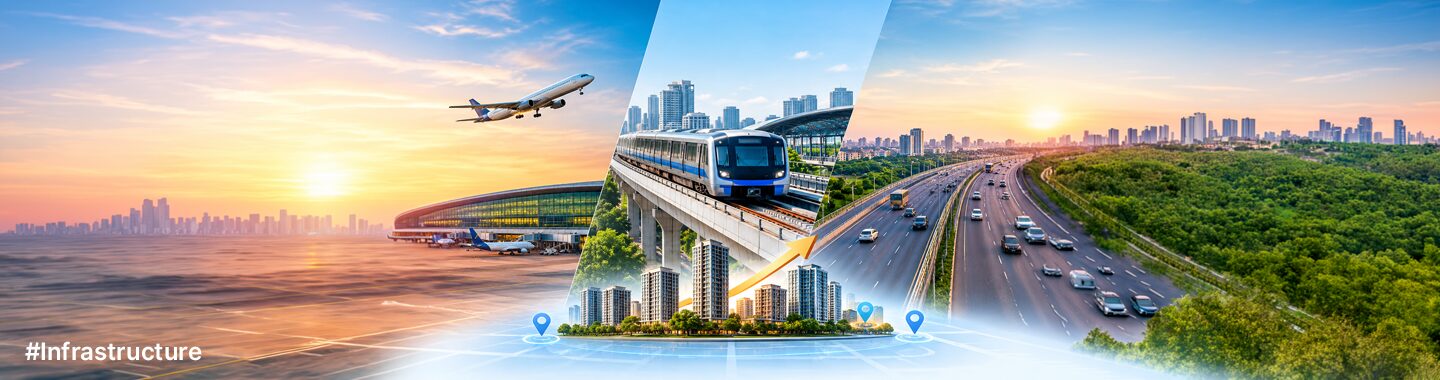
Airport, Metro or Expressway? Which Infrastructure Actually Moves Property Markets?
A new metro line opens. A new airport is announced. An expressway connects two previously distant locations.
Almost immediately, another question follows:
What will happen to property prices?
Infrastructure and real estate have always been closely connected. Better connectivity can reduce travel time, open up employment opportunities and make previously distant locations more accessible.
But not every infrastructure project has the same impact.
A metro station, airport and expressway solve different problems. Their influence on property markets also depends on what they connect, how quickly they become operational and whether residential demand exists around them.
So which one matters most?
The answer is not as simple as choosing one.
Metro: The Everyday Connectivity Multiplier
Metro infrastructure has one obvious advantage: it can influence everyday commuting.
For residential markets, that can be particularly significant.
A buyer may accept a location farther from the city centre if a reliable transit connection makes the daily commute manageable.
This is why metro property appreciation is often discussed alongside accessibility.
But proximity alone is not enough.
A project located near a station may benefit differently depending on:
- Walking distance
- Station connectivity
- Employment centres served by the line
- Frequency and reliability
- Availability of feeder transport
- Existing residential demand
A metro line can improve accessibility.
It does not automatically make every nearby property a good investment.
Airports: More Than Passenger Traffic
Airports influence property markets differently.
An airport can bring together tourism, aviation, hospitality, logistics, business travel and employment.
That can create demand across multiple real estate categories.
Residential development can benefit when employment centres and supporting infrastructure grow around the airport.
Commercial and hospitality real estate may also become more relevant.
This makes airport real estate particularly interesting when an airport forms part of a larger economic ecosystem.
Again, the important question is not simply:
“How close is the property to the airport?”
It is:
“What economic activity is the airport helping create around it?”
Expressways: The Geography Changer
Expressways can alter the geography of a region by making longer-distance movement faster.
For residential markets, this can open up peripheral locations to buyers who previously considered them too far away.
For businesses, improved road connectivity can influence logistics and access to larger markets.
This is where expressway property growth becomes a useful concept.
But road connectivity alone does not guarantee sustained demand.
An expressway becomes more meaningful when it connects a residential location to something people actually need: employment, education, commerce, airports, industrial areas or other urban centres.
The Real Question: What Does It Connect?
This is perhaps the most important infrastructure question for a property buyer.
Don’t ask only:
“Is there a metro nearby?”
Ask:
“Where does that metro take me?”
Don’t ask only:
“How close is the airport?”
Ask:
“What employment and economic ecosystem is developing around it?”
Don’t ask only:
“Is there an expressway?”
Ask:
“Which important destinations does it make more accessible?”
Connectivity creates value when it reduces friction between people and opportunities.
Infrastructure Has a Timeline
Another factor buyers often overlook is timing.
Infrastructure typically passes through several stages:
Announcement → Planning → Construction → Partial operation → Full operation → Ecosystem development
Each stage carries a different level of certainty.
A proposed metro line is not the same as an operational metro.
A planned airport is not the same as an airport handling passengers.
An announced road is not the same as a functioning connection.
This distinction is critical when evaluating infrastructure-linked property.
What Happens After Connectivity Improves?
The next question is even more important.
What follows the infrastructure?
New roads and transit networks can make land more accessible.
But sustained property demand generally requires people and economic activity.
Look for:
- Employment hubs
- Commercial development
- Schools
- Healthcare
- Retail
- Hospitality
- Warehousing and logistics
- Existing residential communities
When multiple elements begin appearing together, infrastructure can become part of a broader growth story.
Infrastructure Can Create New Catchment Areas
One of the most interesting effects of major infrastructure is that it can expand the practical catchment area of an established city.
A buyer who once considered a 60-minute commute unacceptable may reconsider if a new transport connection cuts the journey significantly.
That can change where people are willing to live.
Developers often respond by bringing new projects into these expanding catchments.
Over time, what was once considered a peripheral location can become part of the mainstream urban market.
But Infrastructure Isn’t a Guarantee
This is where investors need to be careful.
Infrastructure is a demand enabler, not a guaranteed appreciation mechanism.
A property can sit beside a major road and still underperform if there is weak end-user demand.
Similarly, a metro station may improve accessibility without creating significant price movement if supply is excessive or the surrounding ecosystem remains underdeveloped.
The strongest opportunities tend to emerge when infrastructure meets genuine demand.
A Simple Infrastructure Scorecard
Before considering an infrastructure-linked property, ask five questions:
1. What infrastructure is actually operational?
2. What is under construction?
3. What is only proposed?
4. What important destinations does it connect?
5. What economic and residential activity exists around it?
This creates a more grounded approach to evaluating infrastructure real estate in India.
Metro, Airport or Expressway?
There is no universal winner.
Each serves a different purpose.
Metro: Everyday urban mobility.
Airport: Regional and global connectivity plus economic activity.
Expressway: Faster road-based movement and wider regional access.
The better question is:
Which type of infrastructure is most relevant to the demand drivers of the specific market?
For an office-led corridor, metro access may matter enormously.
For an emerging regional hub, airport connectivity may be transformative.
For a peripheral residential market, an expressway may significantly change accessibility.
Infrastructure Is the Beginning, Not the End
The most useful way to think about infrastructure is as a catalyst.
It can reduce distance.
It can improve accessibility.
It can connect markets.
It can attract businesses.
It can influence where people choose to live.
But the property story becomes stronger when these effects combine with actual demand.
So before buying into the next infrastructure-led growth story, look beyond the ribbon-cutting ceremony.
Study the connection. Study the demand. Study the timeline.
Because in real estate, the most valuable infrastructure isn’t necessarily the biggest project.
It is the one that meaningfully changes how people and places connect.
Explore infrastructure-linked projects.
#Infrastructure #RealEstateGrowth #MetroRealEstate #PropertyInvestment #PropTechIndia