Mumbai’s Next Growth Map: Which Corridors Are Reshaping the Region in 2026?
Mumbai’s property map is no longer defined only by South Mumbai, the western suburbs and the established central corridors.
The wider Mumbai Metropolitan Region is becoming increasingly interconnected.
New infrastructure, expanding employment centres, airport connectivity and suburban growth are changing how people think about distance.
This is why Mumbai growth corridors deserve closer attention.
For buyers and investors, the question is no longer simply:
“Where is Mumbai?”
It is:
“Where is the Mumbai region moving?”
Why the Region Is Expanding
Mumbai faces a basic geographical challenge: limited land within its established urban core.
As population and economic activity grow, development naturally pushes outward.
But outward expansion only becomes meaningful when connectivity catches up.
That is where infrastructure becomes important.
Improved road, rail and transit connections can make peripheral locations more practical for both residents and businesses.
Over time, this can create new urban corridors.
Navi Mumbai: From Satellite City to Major Urban Centre
Navi Mumbai real estate has a long history of planned development.
Its appeal has been shaped by planned nodes, wider roads, infrastructure and proximity to Mumbai.
The region’s future growth story is also linked to its expanding economic and transport ecosystem.
For buyers, the key is to move beyond the broad “Navi Mumbai” label.
Different nodes have different demand drivers.
Some are more established.
Some are still developing.
Some benefit from stronger commercial activity.
Others offer comparatively newer residential supply.
The micro-market matters.
Panvel: A Strategic Connector
Panvel occupies an important position in the wider regional network.
Its relevance comes partly from its relationship with multiple transport corridors and surrounding growth areas.
This makes Panvel property trends worth tracking as part of the larger regional story.
But again, infrastructure alone is not enough.
Investors should examine:
- Residential absorption
- Employment
- Commercial development
- Social infrastructure
- Existing connectivity
- New supply
- Rental demand
The stronger the ecosystem, the more sustainable the residential story can become.
The Airport Effect
One of the most significant infrastructure themes shaping the broader region is improved airport connectivity.
An airport can influence more than travel.
It can attract business activity, hospitality, logistics, offices and supporting services.
That can create employment.
Employment can create housing demand.
Housing demand can encourage further development.
This is how infrastructure can gradually reshape a property map.
But investors should track actual progress and usage rather than treating an airport announcement as an automatic property-price signal.
The Expressway Effect
Major road infrastructure can also change the regional equation.
Improved road connectivity can shorten travel between Mumbai, Navi Mumbai, Panvel and surrounding markets.
For residents, this can expand the practical range of locations they consider.
For businesses, it can improve access to employees, customers and logistics networks.
For developers, it can create new development opportunities.
The impact therefore extends beyond residential property.
Why Growth Corridors Matter
A growth corridor is more than a road between two places.
It is an area where multiple growth factors begin converging.
Infrastructure
Employment
Housing
Commercial activity
Social infrastructure
Population
When these elements reinforce each other, the corridor can become a more independent economic ecosystem.
That is what makes corridor analysis more useful than simply looking at today’s property prices.
Mumbai’s Future Is Likely to Be More Regional
The Mumbai Metropolitan Region increasingly functions as an interconnected economic geography.
People may live in one node, work in another, shop in a third and travel through a fourth.
This makes connectivity increasingly important.
A buyer should therefore evaluate a property not only by its distance from Mumbai’s traditional centres but also by how it connects to the broader region.
What Should Buyers Look For?
If you’re exploring Mumbai growth markets, consider five questions.
1. How accessible is the location today?
Don’t rely only on future infrastructure.
2. What is changing?
Identify projects that are operational, under construction or formally progressing.
3. Where are jobs coming from?
Residential demand needs an economic base.
4. Is the social ecosystem developing?
Schools, hospitals, retail and leisure matter.
5. How much supply is entering?
A promising market can still face pressure from oversupply.
Established vs Emerging
Mumbai’s established markets have one major advantage: mature ecosystems.
Emerging markets have a different proposition.
They may offer:
- Newer housing
- Larger configurations
- Different entry points
- Infrastructure-led potential
- More development runway
But they can also involve greater uncertainty.
There is no universal answer.
The right choice depends on the buyer’s budget, time horizon and objective.
Don’t Evaluate the MMR as One Market
This may be the most important takeaway.
The Mumbai region contains multiple property markets.
Mumbai city
Navi Mumbai
Panvel
Thane
Mira-Bhayandar
Vasai-Virar
and several emerging corridors each have different supply-demand dynamics.
A city-level headline can therefore hide important differences.
For serious property research, go one level deeper.
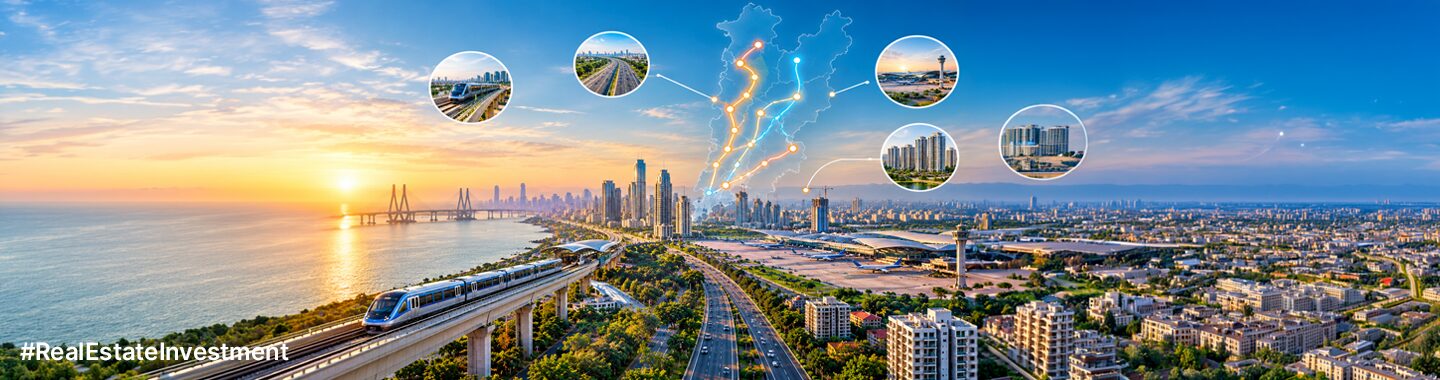
The New Mumbai Property Map
The future Mumbai property map is increasingly being shaped by connections.
Airports.
Roads.
Rail.
Business districts.
New residential communities.
Commercial hubs.
As these elements develop, the boundaries between established and emerging markets can become less rigid.
For buyers, this creates more choice.
For investors, it creates more markets to analyse.
But more choice also means more need for research.
The opportunity is not simply to find a location that is growing.
It is to understand why it is growing, how sustainable that growth may be and whether the property fits your objective.
Mumbai’s next property story may not belong to one neighbourhood.
It may belong to the network connecting several of them.
Explore Mumbai growth markets.
#MumbaiRealEstate #NaviMumbai #Panvel #RealEstateInvestment #PropertyPistol