Why Mixed-Use Developments Are Becoming the Future of Urban Living
What if your home, workplace, supermarket, restaurant, school, healthcare centre and recreational space were all part of the same ecosystem?
That is the promise of mixed-use development.
And as Indian cities become denser and commutes become more challenging, the concept is gaining relevance.
The real estate industry is increasingly moving beyond isolated residential buildings towards integrated urban ecosystems that combine homes with commercial, retail, hospitality, healthcare, education, entertainment and green spaces. Recent industry discussions in 2026 point to this shift towards complete, experience-led urban environments.
The reason is simple:
People don’t just buy homes. They buy access to a way of life.
Explore integrated communities with PropertyPistol.
What Is a Mixed-Use Development?
A mixed-use project combines multiple functions within one development or interconnected urban district.
This can include:
- Residential
- Retail
- Offices
- Restaurants
- Hotels
- Schools
- Healthcare
- Entertainment
- Parks and public spaces
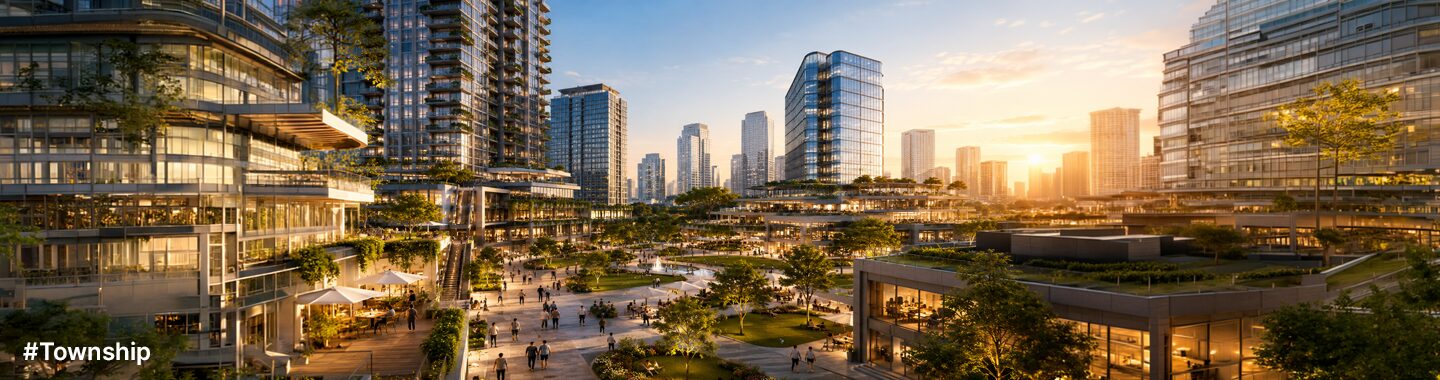
An integrated township takes the idea further by creating a large-scale community where many daily needs are planned within the same ecosystem.
The goal is to reduce the need to travel long distances for everyday activities.
1. The Biggest Luxury: Time
Modern urban life is increasingly defined by time spent commuting.
A person may spend hours travelling between:
Home → Office → School → Grocery store → Gym → Restaurant → Home
Integrated communities attempt to shorten this chain.
If a resident can access several needs within the same development or nearby ecosystem, daily life becomes more convenient.
That makes time one of the most valuable benefits of mixed-use development.
2. Live-Work-Play Is Becoming More Relevant
The old model of urban planning often separated:
- Residential areas
- Offices
- Retail
- Entertainment
The mixed-use model brings them closer.
This can create a more active neighbourhood throughout the day.
Morning:
People commute to work.
Afternoon:
Retail and commercial activity continues.
Evening:
Restaurants, parks and entertainment become active.
The result is a more dynamic environment than a purely residential neighbourhood.
3. Integrated Townships Can Create Stronger Community Ecosystems
One of the biggest advantages of an integrated township is scale.
A larger development can potentially support:
- Larger green spaces
- Sports facilities
- Clubhouses
- Schools
- Retail
- Healthcare
- Walking paths
- Community spaces
This can create opportunities for residents to interact beyond the confines of individual apartment towers.
For families, this can be particularly attractive.
Children have play areas.
Senior citizens have walking spaces.
Young professionals have cafes and recreational facilities.
The community becomes part of the product.
4. Better Infrastructure Planning
Large mixed-use developments can also plan infrastructure more comprehensively.
Instead of adding amenities after residential construction, developers can potentially design:
- Roads
- Parking
- Utilities
- Water systems
- Green spaces
- Retail
- Public areas
as part of one larger plan.
This is particularly important as Indian cities expand.
Urban growth without infrastructure can create congestion.
Integrated planning can potentially reduce that mismatch.
5. The Investment Case
For investors, mixed-use developments offer another interesting proposition.
A well-designed ecosystem can create multiple demand sources.
Residential demand can be supported by:
- Local employees
- Families
- Professionals
- Students
Retail can benefit from:
- Residents
- Office workers
- Visitors
Commercial space can benefit from:
- Businesses
- Startups
- Corporate occupiers
That creates a broader economic ecosystem.
But this does not mean every mixed-use project will perform well.
6. Integration Has to Be Real
A project can have residential towers, shops and an office building on the same master plan and still fail to operate as a genuine mixed-use ecosystem.
Investors should ask:
Are the components actually connected?
Will the retail have enough footfall?
Are offices occupied?
Is there enough social infrastructure?
Are the roads and public areas well planned?
Is the township accessible from outside?
The difference between mixed-use on paper and mixed-use in practice can be significant.
7. Location Still Beats the Brochure
An integrated development cannot compensate indefinitely for a weak location.
The surrounding city still matters.
A buyer should evaluate:
- Employment hubs
- Metro and road connectivity
- Schools
- Hospitals
- Airport access
- Commercial activity
- Future infrastructure
The strongest mixed-use projects are often located where the broader city is already expanding.
8. Sustainability Is Becoming Part of the Equation
Large developments can also incorporate sustainability at scale.
That may include:
- Rainwater harvesting
- Solar energy
- Waste management
- Water recycling
- Energy-efficient buildings
- Green spaces
- Walkable areas
This isn’t just about environmental responsibility.
Efficient infrastructure can also influence long-term operating costs and liveability.
9. Mixed-Use Developments and the Future Buyer
Today’s homebuyer increasingly wants more than an apartment.
They want convenience.
They want amenities.
They want community.
They want access.
They want better use of time.
And increasingly, they want the neighbourhood to work as well as the home itself.
That is why integrated townships are becoming more relevant.
What Should Buyers Check Before Choosing an Integrated Township?
Use this checklist:
Location
Does the wider neighbourhood have strong fundamentals?
Connectivity
How accessible is the township?
Internal infrastructure
Are roads, parking and utilities planned well?
Amenities
Are they actually usable or simply promotional?
Commercial component
Will retail and commercial spaces have sufficient demand?
Social infrastructure
Are schools, healthcare and everyday services available?
Developer track record
Can the developer execute a large-scale development?
Maintenance
What will it cost to maintain the ecosystem?
These questions can help determine whether the “integrated” promise is genuinely valuable.
The Future of Urban Living May Be Less About Buildings
The next generation of Indian real estate may increasingly be defined by ecosystems rather than individual buildings.
A home becomes more valuable when the neighbourhood works.
A neighbourhood becomes stronger when jobs, retail and services are accessible.
And a city becomes more liveable when people spend less time travelling for everyday needs.
That is the core idea behind mixed-use development.
Not simply:
More amenities.
But:
More life within reach.
Explore Integrated Communities With PropertyPistol
Choosing an integrated township requires evaluating the entire ecosystem—not just the apartment.
PropertyPistol can help you explore projects and locations based on connectivity, amenities, development quality and long-term potential.
Explore integrated communities with PropertyPistol.
CTA: Explore integrated communities with PropertyPistol.
#UrbanLiving #Township