The Infrastructure Effect: How One New Connection Can Rewrite an Entire Property Map
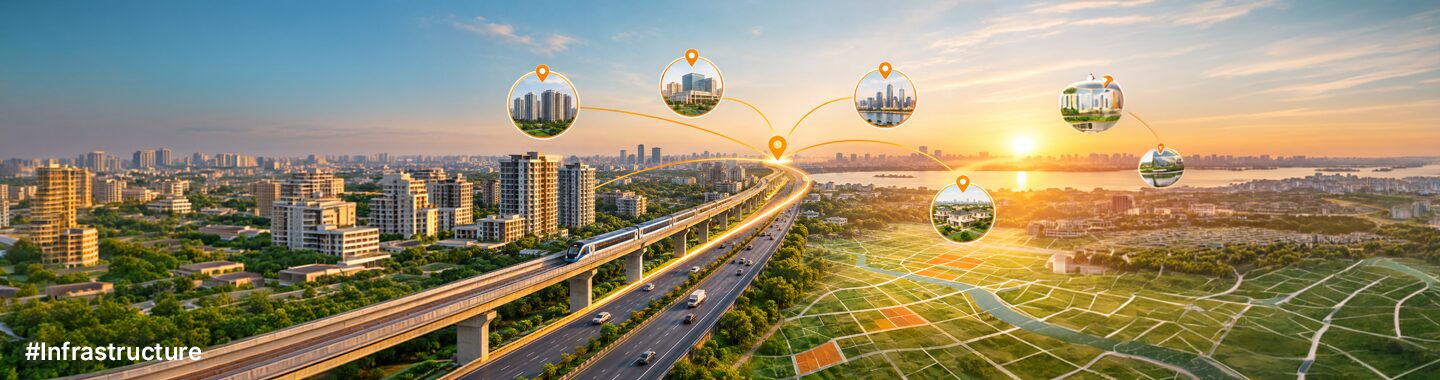
A bridge can save an hour. A metro line can make a distant suburb accessible.
An expressway can connect an emerging town to a major city.
An airport can introduce an entirely new economic ecosystem.
And once connectivity changes, the property map can change with it.
This is the basic idea behind infrastructure-led growth.
But the real estate impact of infrastructure is not simply about putting a road or rail line on a map.
It is about changing the relationship between people, places and opportunities.
Distance Is Not the Same as Accessibility
Two locations can be physically close but functionally far apart.
A river, railway line, congested road or limited transport options can create friction.
Infrastructure reduces that friction.
A new connection can make a location easier to reach from employment centres, commercial districts, airports or other cities.
This is why connectivity and real estate are so closely linked.
The value isn’t necessarily in the infrastructure itself.
It is in what the infrastructure makes possible.
The First Effect: A Larger Catchment
When travel becomes easier, the number of people who can realistically consider an area can increase.
A buyer who previously wanted to live within 10 kilometres of a workplace may become comfortable living farther away if the journey becomes significantly easier.
That expands the practical catchment of the market.
Developers respond to this change.
New projects enter.
Commercial activity follows.
Retail and services develop.
The area begins attracting more residents.
That can create a feedback loop.
The Second Effect: Employment Follows Accessibility
Infrastructure can also influence where businesses locate.
Better roads and transit can make commercial or industrial areas easier to access.
When jobs appear, housing demand can follow.
This is one reason investors should look at employment when evaluating growth corridors in India.
A road without economic activity may improve travel.
A road connecting people to jobs can potentially transform a property market.
The Third Effect: Land Becomes More Relevant
Infrastructure can change how developers perceive land.
An area previously considered too remote may become commercially viable once accessibility improves.
This can lead to land assembly, new development and changes in land use.
However, this is also where speculation can become dangerous.
A proposed infrastructure project can generate expectations long before actual construction begins.
Investors need to separate the infrastructure story from the infrastructure reality.
The Infrastructure Timeline
Every major project has a lifecycle.
Announcement
The project enters public discussion.
Approval
Formal processes progress.
Construction
Physical development begins.
Operation
The connection becomes usable.
Adoption
People and businesses begin changing behaviour around it.
The property impact may evolve across each stage.
An announcement can create sentiment.
Construction can create confidence.
Operational infrastructure can create actual accessibility.
Adoption is when the wider economic effect begins becoming visible.
Not All Connections Are Equal
A new road is not automatically transformative.
A metro station is not automatically a property multiplier.
An airport is not automatically an investment opportunity.
The quality of the connection matters.
Ask:
What does it connect?
How much time does it save?
Who uses it?
What economic activity does it enable?
What alternative routes already exist?
These questions help distinguish meaningful infrastructure from infrastructure that simply sounds impressive.
Watch the Second-Order Effects
The most interesting real estate impact can sometimes occur after the infrastructure itself is completed.
A new connection may lead to:
- New offices
- Retail centres
- Schools
- Hospitals
- Hotels
- Logistics hubs
- Residential projects
- Entertainment districts
These are second-order effects.
They can be more important to property demand than the original infrastructure project.
The Property Appreciation Question
Investors often ask whether infrastructure will increase property prices.
The answer depends on several variables.
Infrastructure can improve accessibility.
Improved accessibility can increase demand.
Higher demand can influence pricing.
But the relationship is not automatic.
Supply matters.
Affordability matters.
Execution matters.
Economic activity matters.
And timing matters.
This is why property appreciation should be treated as an outcome of multiple market forces rather than a guaranteed result of connectivity.
A Growth Corridor Is a System
A genuine growth corridor typically contains several interconnected elements.
Transport
How do people move?
Employment
Where do they work?
Housing
Where do they live?
Commerce
Where do they shop and spend?
Social infrastructure
Where do they go to school, receive healthcare and spend leisure time?
Investment
Where is capital flowing?
The more of these elements develop together, the more meaningful the corridor can become.
How Buyers Can Track the Effect
You don’t need complicated models to begin researching an infrastructure-led market.
Track a few things consistently.
Travel times
How long does it actually take to reach key destinations?
Construction progress
Is the infrastructure physically progressing?
Development activity
Are credible developers entering?
Employment
Are businesses expanding nearby?
Population
Are people moving into the area?
Rental demand
Are homes being occupied?
These indicators provide a more grounded picture than headlines alone.
Don’t Buy the Infrastructure. Buy the Demand It Creates.
This is perhaps the most useful principle.
A property investor isn’t really investing in a metro line.
They are investing in the demand that the metro may help create.
They aren’t investing in an airport.
They are investing in the economic and residential ecosystem that may develop around improved connectivity.
That distinction keeps the analysis grounded.
The Property Map Is Always Moving
Cities are not static.
Every new connection can change how people perceive distance.
A location that once seemed remote can become accessible.
A suburb can become a business hub.
A peripheral market can become part of a larger metropolitan region.
That is the power of infrastructure.
But the smartest property decisions don’t stop at the infrastructure announcement.
They ask what happens next.
Who comes?
What gets built?
Where do jobs emerge?
How quickly does demand follow?
Because one connection can rewrite the property map.
But the real opportunity lies in understanding why.
Explore growth corridors.
#Infrastructure #Connectivity #RealEstateGrowth #Investment #PropertyPistol
——————————————————-