Delhi NCR in 2026: The New Growth Corridors Every Buyer Should Watch
Delhi NCR’s property market is undergoing a major geographical shift.
The centre of attention is moving beyond established Delhi neighbourhoods and traditional Gurugram addresses towards new growth corridors where infrastructure, employment and large-scale development are converging.
The numbers are telling.
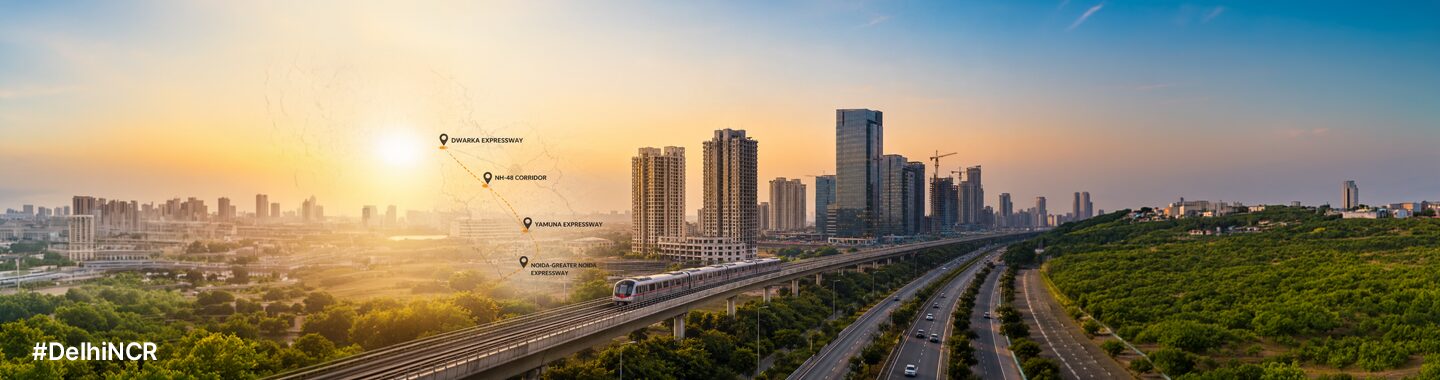
In Q1 2026, Delhi NCR recorded 10,740 residential apartment sales. Gurugram accounted for 53% of quarterly sales, while Noida contributed 38%. The strongest activity was concentrated around Dwarka Expressway, Manesar and the Noida-Greater Noida Expressway.
At the same time, NCR’s new supply is increasingly shifting towards peripheral locations. Cushman & Wakefield identified Manesar, Dwarka Expressway and New Gurgaon as leading launch locations in Q1 2026.
This makes one thing clear:
The next NCR opportunity may be less about the city you buy in and more about the corridor you buy along.
Find your ideal investment in NCR.
Why Growth Corridors Matter More Than Ever
A growth corridor is more than a stretch of land between two established areas.
It is a location where several growth factors are beginning to converge:
- New transport infrastructure
- Employment centres
- Commercial development
- Residential expansion
- Improved social infrastructure
- Better regional connectivity
When these elements come together, a location can move through a familiar cycle:
Infrastructure → accessibility → jobs → population movement → housing demand → commercial development
That is why NCR’s peripheral markets deserve attention in 2026.
1. Dwarka Expressway: From Alternative Route to Major Residential Corridor
Dwarka Expressway has evolved significantly from its earlier identity as an emerging connectivity project.
It is now one of NCR’s most active residential corridors.
Cushman & Wakefield reported that the corridor added around 2,500 residential units in Q1 2026 and accounted for a 36% share of Gurugram’s new launches in its peripheral markets. The report links its momentum to improved airport connectivity, UER-II integration and pricing advantages compared with central Gurugram.
For buyers, this creates a compelling combination:
Connectivity + development + relative value
But buyers should still evaluate individual sectors carefully.
Infrastructure-led growth can create significant differences between neighbouring locations depending on access to roads, metro, schools, retail and employment.
2. Manesar: Where Employment and Housing Can Grow Together
Manesar’s strongest argument is not just residential.
It is economic.
Industrial, manufacturing, logistics and commercial activity provide the employment base that can support long-term housing demand.
JLL identified Manesar among the key micro-markets driving Gurugram’s new launches in Q1 2026.
For investors, employment-led demand is particularly important.
A location with jobs can create:
- End-user demand
- Rental demand
- Supporting retail
- Social infrastructure
- Long-term population growth
That is a stronger foundation than speculation alone.
3. New Gurgaon: The Expansion Zone
New Gurgaon is becoming increasingly relevant for buyers looking for newer housing stock and access to the larger Gurugram ecosystem.
Its attraction lies in the combination of:
- New residential projects
- Access to established Gurugram
- Expressway connectivity
- Expanding commercial ecosystem
- Larger-format developments
For buyers, it can offer a middle ground between established Gurugram and more distant emerging markets.
4. Noida-Greater Noida Expressway: The Other Major Growth Engine
The Noida-Greater Noida Expressway is one of NCR’s most important development corridors.
It combines residential expansion with a growing commercial and technology ecosystem.
The corridor is home to major IT/ITeS developments, while sectors along the expressway benefit from access to established Noida business districts.
This is important because commercial development creates residential demand.
Professionals working in nearby offices naturally generate demand for homes and rentals.
That makes employment-linked corridors particularly valuable for long-term investors.
5. Noida Is Challenging Gurugram’s Premium Narrative
Gurugram remains NCR’s dominant premium residential market.
But Noida is increasingly competing for the same buyer.
Premium housing demand is expanding across Noida, supported by infrastructure, planned urban development and growing buyer interest.
This is an important shift because buyers now have more choices.
The comparison is no longer simply:
Delhi vs Gurugram
It is increasingly:
Gurugram vs Noida vs Greater Noida vs emerging NCR corridors
Each has a different proposition.
6. The Airport Effect
Large infrastructure projects can reshape the way buyers perceive a location.
Noida International Airport is a particularly significant factor in the wider NCR development story.
The proposed Ghaziabad–Noida Airport Namo Bharat corridor is among the new regional connectivity corridors being considered for NCR, alongside a proposed Delhi–Karnal connection.
But buyers should avoid one common mistake:
Don’t buy only because an airport is nearby.
Instead, assess what the airport is bringing with it:
- Business activity
- Logistics
- Hotels
- Offices
- Retail
- Employment
- Road and rail infrastructure
That broader ecosystem is what creates durable property demand.
7. Premiumisation Is Reshaping NCR
NCR is no longer primarily an affordable housing story.
Premium and luxury housing have become increasingly important.
Q1 2026 saw NCR register strong demand for homes above ₹1 crore, with the region benefiting from rising incomes, lifestyle aspirations and investment confidence.
This is changing the product being developed.
Buyers increasingly expect:
- Larger homes
- Better amenities
- High-quality clubhouses
- Smart-home features
- Green spaces
- Security
- Better location
- Stronger community infrastructure
The result?
The NCR market is becoming increasingly value-driven rather than volume-driven.
8. How Should You Evaluate an NCR Growth Corridor?
Before investing, look at six factors:
1. Infrastructure
Is the promised infrastructure operational, under construction or merely proposed?
2. Employment
Where are the jobs coming from?
3. Residential absorption
Are homes actually being occupied?
4. Supply pipeline
How much competing inventory is coming?
5. Social infrastructure
Are schools, hospitals, retail and everyday amenities keeping pace?
6. Entry price
Does the current price adequately reflect the future growth story?
This last question is critical.
A good corridor can become a poor investment if the future has already been completely priced in.
The NCR Investment Map Is Getting Bigger
Delhi NCR’s real estate market in 2026 is no longer about buying into an established address.
It is about identifying the next layer of urban growth.
Dwarka Expressway offers connectivity-led expansion.
Manesar combines employment and residential growth.
New Gurgaon continues to expand the Gurugram ecosystem.
Noida-Greater Noida Expressway benefits from commercial development and regional connectivity.
And the wider airport-led ecosystem could reshape parts of the NCR investment map further.
The smartest buyer is therefore not necessarily the one who identifies the most talked-about location.
It is the one who understands why demand is moving there.
Find Your Ideal NCR Investment
With multiple corridors developing at different speeds, comparing projects purely on price can be misleading.
PropertyPistol can help you evaluate NCR opportunities based on location, connectivity, project quality, investment objective and long-term potential.
Find your ideal investment in NCR.
CTA: Find your ideal investment in NCR.
#DelhiNCR #RealEstate #Investment