From Expo 2020 to New Urban Hubs: What Dubai’s Real Estate Transformation Teaches India
Dubai has built a reputation for doing something few cities manage well:
turning large-scale infrastructure and global events into long-term urban growth.
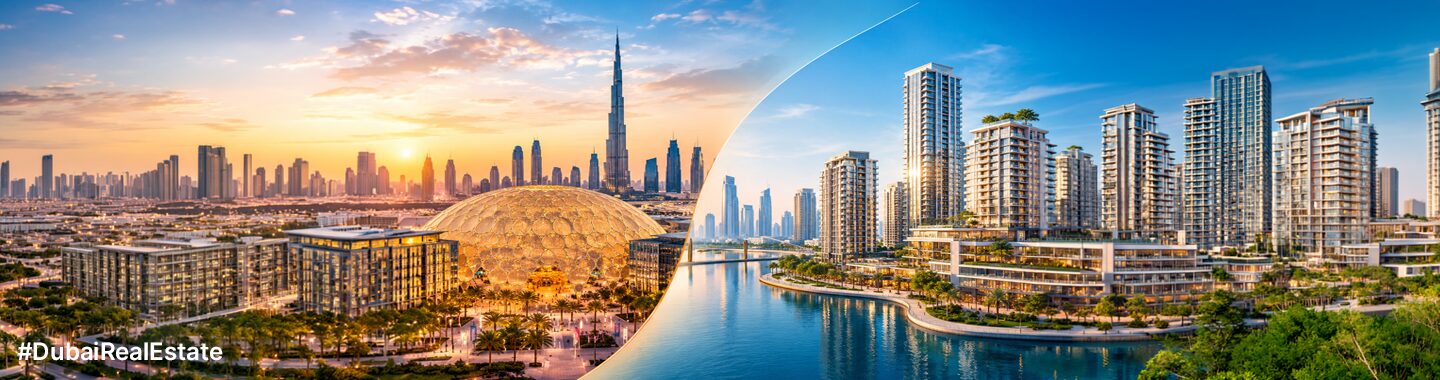
The clearest example is the transformation around Expo 2020 Dubai.
What was once an event site has evolved into Expo City Dubai, an emerging mixed-use urban district designed around residential, commercial, cultural and sustainability-focused development.
The larger lesson isn’t simply about Dubai.
It is about how a city can use a major global event as a catalyst for something much bigger: new infrastructure, new business districts, new communities and new real estate demand.
For India, which is preparing for an increasingly urban future and developing new economic corridors, Dubai’s experience offers several useful lessons.
Explore global property insights.
From Expo Site to Urban District
Expo 2020 Dubai was held between October 2021 and March 2022 after being postponed from 2020 because of the pandemic.
But the more interesting story began after the event ended.
Rather than treating the Expo site as a temporary destination, Dubai positioned it as a long-term urban development.
Expo City Dubai is being developed as a mixed-use district with residential, commercial, cultural and educational components, while retaining several landmarks from the Expo.
This represents an important shift in urban planning:
An event becomes an ecosystem.
And an ecosystem can create sustained real estate demand.
1. Infrastructure Should Outlive the Event
The first lesson is perhaps the simplest.
Large infrastructure investments create greater long-term value when they continue serving people after the original event is over.
Expo 2020 brought new:
- Transport infrastructure
- Public spaces
- Commercial opportunities
- Hospitality capacity
- Digital infrastructure
- Urban services
The challenge after any major event is avoiding underused infrastructure.
Dubai’s approach has been to integrate the former Expo site into the city’s longer-term development plans.
For Indian cities, this is particularly relevant as the country develops new airports, metro networks, expressways, exhibition centres and large event infrastructure.
The question should not only be:
“What will this infrastructure enable today?”
It should also be:
“What urban ecosystem can grow around it tomorrow?”
2. Connectivity Can Create New Property Corridors
One of the strongest relationships in real estate is between connectivity and accessibility.
Expo City Dubai benefits from its connection to Dubai Metro’s Route 2020, which was developed to connect the Expo site with other parts of the city.
This changes the development equation.
A location that might previously have been considered peripheral can become more relevant when it is connected efficiently to employment, commercial and residential hubs.
India is seeing a similar phenomenon.
Metro expansion, expressways, airports and regional rail are creating new development corridors around cities such as:
- Mumbai
- Delhi NCR
- Bengaluru
- Hyderabad
- Pune
- Ahmedabad
- Chennai
The lesson is not to buy simply because a new transport project has been announced.
Instead, investors should watch where connectivity intersects with employment, housing demand and social infrastructure.
3. Build the Ecosystem, Not Just the Landmark
A landmark can attract attention.
An ecosystem creates reasons to stay.
Expo City is being developed with a mix of uses rather than as a standalone attraction.
This reflects a broader global real estate trend towards mixed-use urban districts.
A successful urban hub can combine:
Homes + Offices + Retail + Hospitality + Culture + Recreation + Public Spaces
This creates activity throughout the day.
People live there.
People work there.
People visit.
Businesses operate there.
And services emerge around them.
India’s new urban developments can take a similar approach.
Instead of building isolated residential projects around infrastructure, developers and planners can think about creating complete neighbourhoods.
4. Employment Is the Real Engine of Residential Demand
One of the most important lessons for Indian real estate is that infrastructure alone cannot sustain a residential market indefinitely.
People need reasons to live in a location.
Employment is one of the strongest.
Dubai’s broader urban strategy has increasingly linked commercial, business and residential development.
For India, emerging corridors should therefore be assessed by asking:
Where will the jobs come from?
A new road can improve access.
A new metro can reduce travel time.
But a growing employment ecosystem can create sustained housing demand.
That is why locations near:
- IT parks
- Business districts
- Manufacturing hubs
- Financial centres
- Logistics clusters
- Educational institutions
can have stronger long-term residential potential.
5. Global Events Can Accelerate Urban Transformation
Expo 2020 was more than a six-month event.
It helped accelerate investment and international attention around a specific part of Dubai.
This raises an interesting question for India.
Could large-scale events create similar development catalysts?
India is increasingly hosting major global events, exhibitions, sporting competitions and business conferences.
Such events can accelerate:
- Airport expansion
- Metro connectivity
- Hospitality
- Retail
- Commercial development
- Public infrastructure
But the real value comes when these investments remain useful after the event.
The strongest outcome isn’t:
A successful event.
It is:
A stronger city because the event happened.
6. Sustainability Is Moving Into the Core of Urban Planning
Another important lesson from Expo City is the growing role of sustainability in large-scale urban development.
The district has been positioned around sustainable design, green spaces and resource efficiency.
This reflects a wider change in global real estate.
Sustainability is increasingly moving beyond a marketing feature and into:
- Building design
- Energy efficiency
- Water management
- Mobility
- Landscaping
- Waste management
- Community planning
Indian cities face even greater pressure to adopt such approaches as urban populations grow.
The future neighbourhood may need to deliver not just more homes, but more efficient ways of living.
7. PropTech Can Help New Urban Hubs Function Better
Technology is another part of the transformation.
A modern urban district can use technology across:
- Mobility
- Security
- Energy
- Property management
- Digital access
- Building operations
- Resident services
This is where PropTech becomes more than a buzzword.
The objective is not simply to make buildings “smart.”
It is to make cities more responsive and efficient.
For Indian developers, technology can increasingly help manage large communities where thousands of residents, businesses and visitors interact every day.
8. India Already Has Its Own Emerging Urban Hubs
India doesn’t need to replicate Dubai.
It already has several examples of infrastructure-led urban transformation.
Consider the growth potential around:
Navi Mumbai International Airport
Large-scale airport infrastructure can influence residential, commercial, hospitality and logistics development across an entire region.
GIFT City
A specialised financial and business ecosystem can generate demand beyond office space, including housing, retail and services.
Delhi NCR
Metro, expressways and regional connectivity continue to reshape the relationship between established and emerging urban centres.
Hyderabad’s western corridor
Technology employment has helped transform once-peripheral areas into major residential and commercial districts.
The common thread is clear:
Infrastructure becomes valuable when an ecosystem grows around it.
9. The Indian Real Estate Lesson: Think in Corridors, Not Isolated Projects
For investors, this may be the most useful takeaway.
Instead of looking only at a particular project, study the larger corridor.
Ask:
What infrastructure is coming?
Where are the employment centres?
What businesses are moving in?
What transport connections are being developed?
What social infrastructure exists?
How much residential supply is planned?
Will the area become a destination or simply a collection of projects?
The answers can provide a better understanding of long-term potential than a brochure ever could.
10. The Next Phase of Indian Real Estate May Be About Urban Ecosystems
India’s real estate market is gradually moving beyond the traditional model of individual buildings and standalone developments.
New airports.
Business districts.
Integrated townships.
Transit-oriented developments.
Industrial corridors.
Financial centres.
These can become the foundations of new urban hubs.
And when residential development grows around them, real estate becomes part of a much larger economic story.
That is precisely what makes Dubai’s transformation worth studying.
What Dubai’s Transformation Can Teach Indian Investors
There are five lessons worth remembering:
1. Infrastructure creates possibilities, not guarantees.
2. Employment creates sustainable housing demand.
3. Connectivity can expand a city’s residential map.
4. Mixed-use ecosystems can create stronger urban destinations.
5. Long-term value comes from what remains after the headline event is over.
For investors, this changes the way a future growth corridor should be evaluated.
Don’t simply ask:
“What is being built?”
Ask:
“What will this infrastructure enable people and businesses to do?”
That question can reveal where the next urban hubs may emerge.
Dubai’s Transformation Is a Lesson in Looking Beyond the Landmark
Expo 2020 may have been the starting point for a global event.
But the larger opportunity lies in what came after it.
A former event site is being repositioned as an urban district.
Transport infrastructure is supporting accessibility.
Commercial and residential development are creating new demand.
Technology and sustainability are becoming part of the urban experience.
And the area is being integrated into Dubai’s broader growth story.
For India, the lesson is not to copy Dubai.
It is to think similarly about the long-term life of infrastructure.
Because today’s airport, metro line, business district or event venue could become tomorrow’s urban hub.
Explore Global Property Insights
Understanding global real estate trends can help investors identify patterns that may shape India’s future urban landscape.
PropertyPistol brings together property insights across markets to help buyers and investors understand emerging locations, infrastructure-led growth and evolving investment opportunities.
Explore global property insights.
CTA: Explore global property insights.
#DubaiRealEstate #GlobalRealEstate #UrbanDevelopment #PropertyInvestment #PropTech
—————————————————————