From Expo City to New Urban Districts: How Global Cities Are Designing the Future of Real Estate
A city’s future is rarely built one building at a time.
It is built through the connections between homes, workplaces, transport, public spaces, technology, retail, entertainment and essential services.
That is why some of the world’s most interesting real estate stories are no longer about individual projects. They are about entire urban districts being designed around how people will live and work in the future.
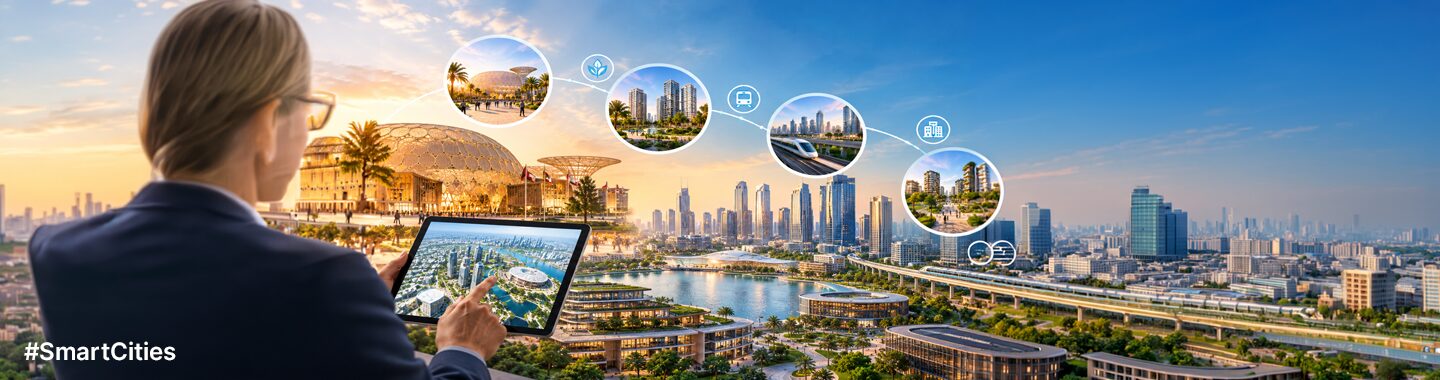
Expo City Dubai is one example of this larger shift: an event destination evolving into a broader urban district. Across global markets, similar ideas are influencing the development of mixed-use communities, transit-oriented neighbourhoods and technology-enabled urban environments.
For India, this raises an important question:
What can the next generation of cities teach us about the next generation of property markets?
From Buildings to Ecosystems
Traditional real estate development often begins with a project.
A residential tower.
An office building.
A shopping centre.
Future-focused urban development increasingly starts with the ecosystem.
Where will people live?
Where will they work?
How will they travel?
Where will they spend their leisure time?
How close are schools, healthcare and everyday services?
When these elements are planned together, the resulting neighbourhood can become more than a collection of buildings.
It becomes an urban ecosystem.
For property buyers, that distinction matters because the quality of the surrounding ecosystem can influence how useful and desirable a property remains over time.
Smart City Real Estate Is About More Than Technology
The phrase “smart city” can immediately bring to mind sensors, apps, automated systems and connected infrastructure.
Technology is certainly part of it.
But smart city real estate is ultimately about using technology and planning to make cities function better.
That could include:
- Intelligent traffic management
- Digital public services
- Efficient energy systems
- Connected transport
- Smart waste management
- Water monitoring
- Better public spaces
- Data-led urban planning
For a resident, the benefit is not the technology itself.
The benefit is a city that is easier to navigate, more efficient to operate and potentially more responsive to changing needs.
Connectivity Becomes a Design Principle
Future cities are also being designed around movement.
The distance between a home and a workplace matters.
So does access to public transport, airports, highways and commercial centres.
This is why transit-oriented development is becoming an important concept in urban planning.
Instead of developing housing independently and connecting it later, planners can build communities around major transport networks.
For property markets, this can create new centres of demand.
An area that was once peripheral can become more relevant when accessibility improves.
But buyers should distinguish between infrastructure that exists, infrastructure under construction and infrastructure that is merely proposed.
The map of tomorrow should not be mistaken for the reality of today.
Mixed-Use Districts Are Changing the Meaning of Convenience
The traditional model of a city separates residential, commercial and leisure zones.
Future-oriented districts increasingly bring these uses closer together.
Imagine living within a community where offices, retail, restaurants, recreation and essential services are accessible without requiring a long commute for every activity.
This is one reason mixed-use development continues to feature prominently in global urban planning.
Convenience itself becomes part of property value.
The question changes from:
“How large is the apartment?”
to:
“How well does the neighbourhood support everyday life?”
What India Can Learn
India is already seeing the development of new urban districts around airports, metro networks, highways, business hubs and planned economic centres.
But the biggest opportunity may be to think beyond individual infrastructure projects.
An airport alone does not create a successful city district.
A metro station alone does not create a community.
A highway alone does not create sustainable residential demand.
The real impact comes when infrastructure connects with employment, housing, commerce and social infrastructure.
That is the difference between a transport project and an urban ecosystem.
The Rise of Experience-Led Neighbourhoods
Future cities are also becoming more experience-led.
People increasingly value access to parks, cultural spaces, restaurants, entertainment, fitness and community areas alongside traditional infrastructure.
This is particularly relevant to younger homebuyers.
For them, a neighbourhood is not merely where the home is located.
It is part of the lifestyle the home provides.
This is likely to influence both residential development and the way buyers evaluate projects.
Sustainability Will Be Built Into the City
Future-focused urban development also has to address resource efficiency.
Water.
Energy.
Waste.
Green cover.
Mobility.
Sustainability is moving from being a project-level feature to becoming an urban planning consideration.
For property buyers, this creates a useful distinction.
A green amenity within a project is one thing.
A neighbourhood designed around walkability, public transport, open spaces and resource efficiency is something broader.
The latter can influence everyday liveability at a much larger scale.
The Investment Lens
What does all this mean for property markets?
Future-ready districts can become interesting because they bring multiple demand drivers together.
But investors should avoid treating every planned city as an automatic opportunity.
A useful framework is:
Infrastructure + Employment + Population + Social Infrastructure + Execution
If these factors begin developing together, the urban district has a stronger foundation for sustained demand.
If only one factor exists, the story may still be early.
The Future City Is Already Being Planned
The most interesting real estate developments of the future may not be individual towers.
They may be entire districts designed around a different way of living.
Global cities are experimenting with connected transport, mixed-use communities, digital infrastructure and experience-led neighbourhoods.
India’s own urban expansion will increasingly require similar thinking.
For property buyers and investors, the lesson is simple:
Don’t just study the building. Study the city being built around it.
Because the future value of a property may depend not only on what stands on its plot today, but on how the surrounding urban ecosystem develops tomorrow.
Discover future-ready property markets.
#FutureCities #SmartCities #UrbanDevelopment #RealEstate #PropTech