Smart Homes 2.0: The Technology Buyers Expect in 2026
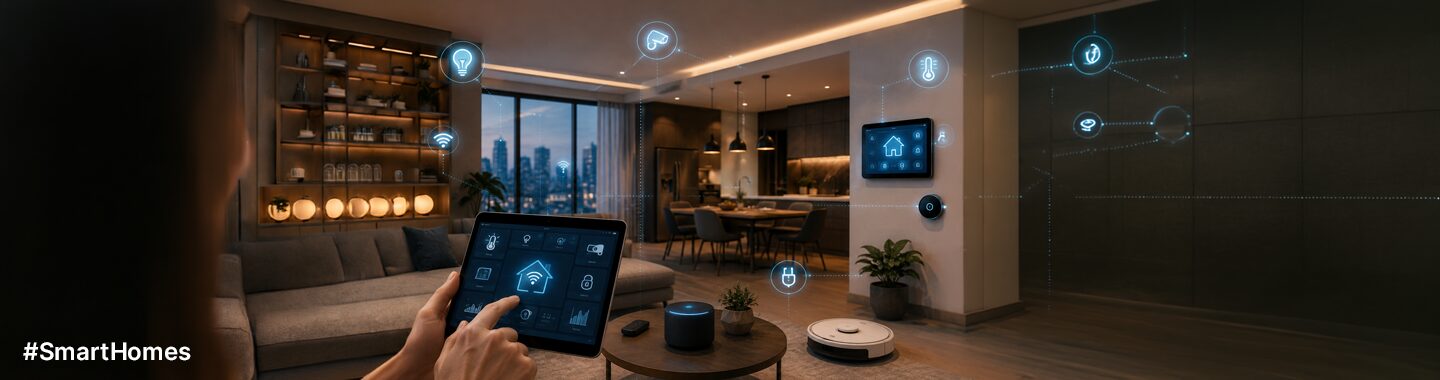
The smart home is no longer just a home where you can switch the lights on with your phone.
In 2026, technology is becoming more deeply integrated into the way homes are secured, managed, powered and experienced.
From smart access and video doorbells to energy management, connected appliances and voice-controlled systems, home automation is moving from a novelty towards a more practical part of modern residential design.
The Indian smart-home market has been driven by growing adoption of IoT, home automation, security and energy-management technologies.
But the next stage isn’t about having the most gadgets.
It’s about having technology that actually makes a home more convenient, efficient and secure.
Find future-ready homes today.
What Is Smart Home 2.0?
The first generation of smart homes was largely about individual devices.
A smart bulb.
A smart speaker.
A smart TV.
A smart lock.
Smart Home 2.0 is about integration.
Instead of separate devices, multiple systems work together.
For example:
You leave home → doors lock → lights switch off → AC adjusts → security system activates.
Or:
You arrive home → access is authenticated → lights turn on → temperature adjusts → selected appliances activate.
The technology becomes less visible.
And that may actually be the sign of a better smart home.
1. Smart Security Is Becoming a Core Feature
Security is one of the most practical applications of home automation.
Today’s systems can include:
- Smart locks
- Video doorbells
- CCTV integration
- Motion sensors
- Access control
- Remote monitoring
- Digital visitor management
For homeowners, the benefit is straightforward:
More visibility and control over who enters the home.
For families and frequent travellers, this can be especially valuable.
But buyers should also consider cybersecurity and data privacy when evaluating connected systems.
2. Energy Management Is Becoming More Important
Smart technology isn’t only about convenience.
It can help homeowners manage energy consumption.
Systems can monitor:
- Electricity usage
- Air-conditioning
- Lighting
- Appliances
- Solar generation
- Battery storage
Smart controls can potentially reduce unnecessary consumption.
This is becoming increasingly relevant as households become more conscious of both energy costs and sustainability.
3. Smart Climate Control
India’s varied climate makes temperature management a major part of home comfort.
Smart thermostats and connected air-conditioning systems can potentially learn usage patterns and adjust automatically.
Instead of manually managing every appliance, the system can optimise comfort around the resident’s routine.
That can make technology useful rather than gimmicky.
4. Smart Lighting Is Moving Beyond “On and Off”
Smart lighting can now be programmed around:
- Time
- Occupancy
- Mood
- Natural light
- Activity
A home can have different lighting scenes for:
Work
Relaxation
Entertainment
Sleep
The advantage isn’t simply aesthetics.
It can also reduce energy wastage when lighting responds to occupancy and usage.
5. Smart Appliances Are Becoming Part of the Ecosystem
Connected refrigerators, washing machines, ovens, air conditioners and other appliances can increasingly be integrated into home systems.
The bigger opportunity is interoperability.
Instead of each device functioning independently, the home becomes a network.
But buyers should ask an important question:
Will today’s technology still work with tomorrow’s devices?
6. AI Is Making Smart Homes More Adaptive
AI can make home automation more responsive.
Instead of simply following commands, future systems can learn patterns.
For example:
If the resident typically turns on the AC before arriving home, the system may eventually predict that behaviour.
If electricity consumption rises unusually, the system may flag it.
If a security sensor detects an unusual pattern, alerts can be triggered.
This changes the idea of a smart home from remote control to assisted decision-making.
7. Smart Homes Need Strong Infrastructure
A smart home is only as reliable as the infrastructure supporting it.
Buyers should check:
- Internet connectivity
- Power backup
- Device compatibility
- Maintenance support
- Software updates
- Data security
- Warranty
- Replacement costs
A flashy smart-home feature is not useful if it stops functioning after a year.
8. Privacy Is the New Smart-Home Question
The more connected a home becomes, the more data it generates.
This can include:
- Entry and exit patterns
- Appliance usage
- Security footage
- Voice commands
- Household routines
That means buyers should understand:
Who stores the data?
Where is it stored?
Who can access it?
How is it protected?
Convenience should not come at the cost of privacy.
9. Which Smart Features Actually Matter?
Not every smart feature adds equal value.
High practical value
- Smart security
- Access control
- Energy management
- Automated lighting
- Climate control
- Water monitoring
Lifestyle value
- Smart entertainment
- Automated curtains
- Voice assistants
- Connected appliances
Buyer should evaluate carefully
- Proprietary systems
- Expensive subscriptions
- Features that require frequent replacement
- Systems that don’t integrate with common platforms
The smartest home isn’t necessarily the one with the most technology.
It is the one where technology solves real problems.
How Smart Homes Could Affect Property Value
Technology may increasingly become part of a property’s overall value proposition.
A home that offers:
Security + efficiency + convenience + adaptability
can potentially stand out in a competitive market.
However, buyers should never allow smart features to distract from fundamentals.
The hierarchy should remain:
Location → Construction quality → Layout → Developer credibility → Connectivity → Liveability → Technology
Smart technology should enhance a good home—not compensate for a weak one.
Smart Home 2.0 Is About Better Living
The future of home automation isn’t about turning your house into a gadget showroom.
It is about making everyday life simpler.
Lights that adapt.
Security that informs you.
Energy systems that reduce waste.
Appliances that work together.
Homes that respond to routines.
And technology that remains mostly invisible while making the experience better.
That’s what makes a home truly future-ready.
Find Future-Ready Homes Today
PropertyPistol can help you explore residential projects where technology, amenities, connectivity and overall liveability come together.
Find future-ready homes today.
CTA: Find future-ready homes today.
#SmartHomes #Technology